
All the evidence for the appraisal meeting in one place
Trainers often support learners alongside their other tasks. mentro collects the evidence from the entries during the semester and shows who needs support. This helps you prepare for your meetings.
Four basics of good mentoring
Reflection needs structure
What happened? Why? What would you do differently next time? Questions like these help with thinking things through.
Prepared questions guide learners through the learning journal. The AI picks them to fit occupation, specialisation and training year.
Give feedback promptly
Shortly after a task, learners can connect your feedback more easily with their experience.
You give feedback right on the journal entry, request changes or approve it.
Keep an eye on every learner
Those who ask little need your support too.
You see who records entries regularly and who has not added any for a while.
Assessment needs evidence
The whole semester counts for the education report.
While filling it in, you see the evidence collected over the semester.
Reflecting early often means better grades
A study followed 132 baker and pastry chef apprentices from across Switzerland through their entire apprenticeship. Those who started their learning journal early and used it to plan, check and correct their work tended to finish with better grades.
Thinking about their own work
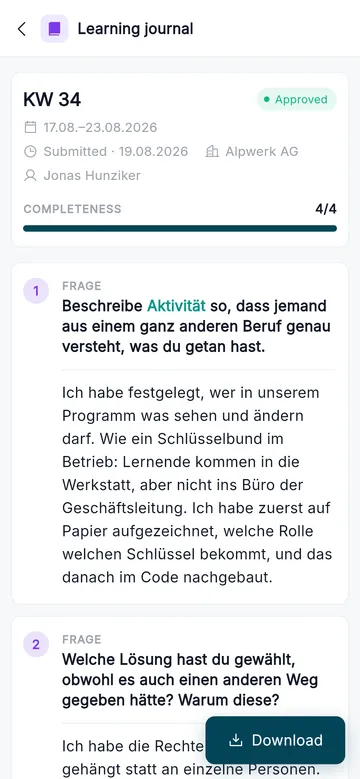
In the learning journal, learners think about what worked, why and what they would do differently next time. In their answers you see how they explain their approach.
- A reflection model with questions that build on each other
- You approve the journal or request changes with feedback
- Learners see your feedback right on the entry
Each learner on one page
Before a meeting, or just in between, you want to know where someone stands without going through five lists. The overview of a learner shows it all in one place: how much of the curriculum is covered, how that has developed since the start of the apprenticeship and where something is due right now.
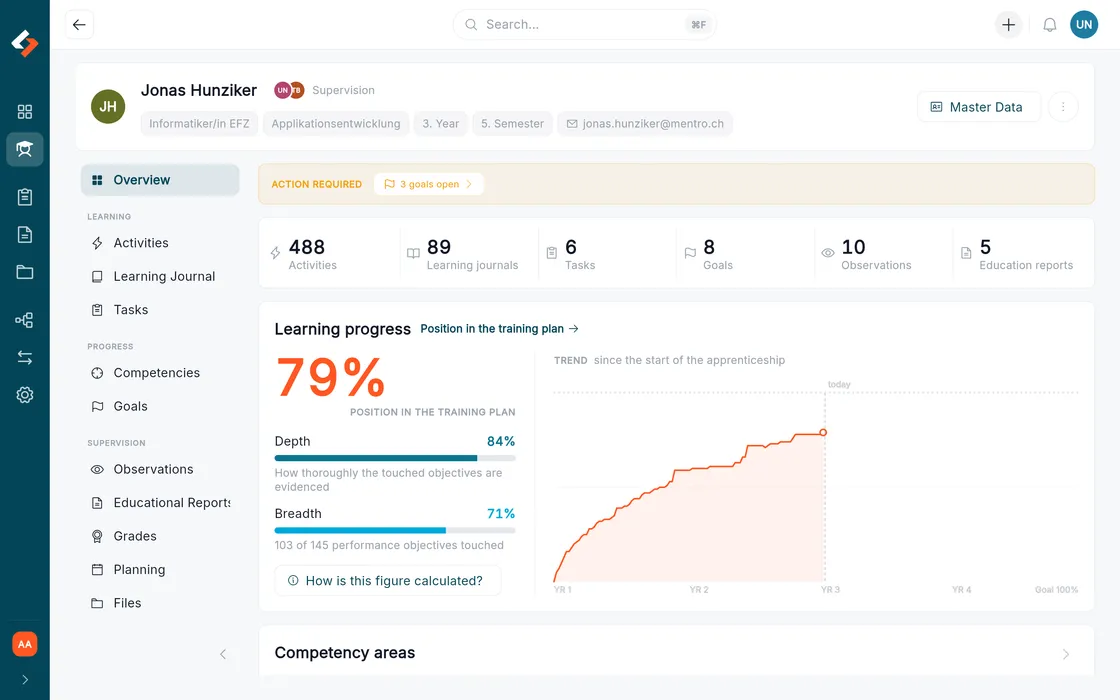
- How many performance objectives already have evidence and how thoroughly they are covered
- Progress since the start of the apprenticeship, year by year
- What needs attention at the top, open goals for example
- All of the person’s entries in one place
Discussing the education report together
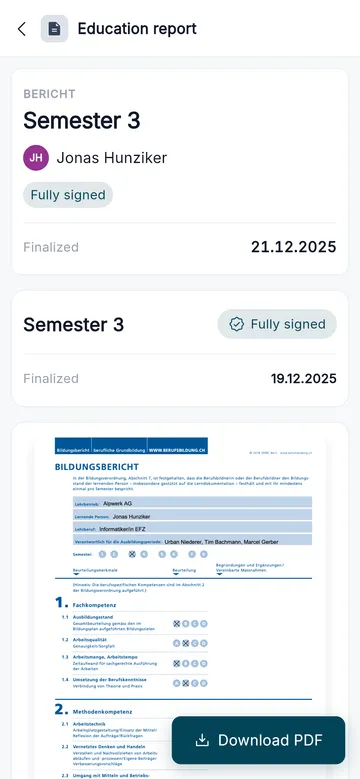
Once a semester, the education report is the chance to take a look together. That works better when both of you have the same documents in front of you. The learner first assesses themselves. Then you fill in the official SDBB form* step by step and see the matching evidence from the semester as you go. You write the assessment.
- The official SDBB form as a PDF
- The learner’s self-assessment next to yours
- Evidence from activities, journals, practical assignments and observations
- Signed electronically by company and learner
* SDBB is the Swiss Services Centre for Vocational Education and Training. It publishes the official education report form used across Swiss vocational education.
Questions from everyday supervision
All questions and answers ›Yes, with high weight. mentro grades every piece of evidence by source. What a professional has confirmed counts most: the signed education report, approved practical assignments and your observations. What learners record themselves counts less. A competency only counts as achieved once several independent sources agree, including at least one observation or review from you as the trainer.
At the end of each semester, so twice a year. The training company records how the learner has developed professionally and personally, and agrees on the goals for the coming semester. In practice the official SDBB form is used for this, and mentro uses exactly that form. It is signed by the trainer and the learner. In mentro the evidence from the whole semester is already there. At the end, you do not have to piece together six months from memory.
An appraisal meeting is the conversation between trainer and learner in which you go through the education report together: what went well, where the learner stands, what comes next. It usually takes place once per semester, together with the education report. To prepare, look at the activities and journals of the past months in mentro, plus the competency picture with the documented and the still open areas. Both sides then enter the conversation with the same facts instead of memories of the last few weeks. At the end, record the agreed goals directly in the report.
Read more: The digital education report
Primarily for trainers in training companies who support their learners. Learners record their activities and reflect on their work. For the company, the information is documented consistently and available in one place.
See mentro with your own eyes
Request your own test environment and see for yourself what everyday work with mentro looks like.
- Access
- Three roles, three access links, by email within minutes
- Sign-in
- No account and no password needed
- Data protection
- Sample data only, deleted automatically after 30 days