
Learning documentation, Computer Science VET
What belongs in it, what the training ordinance requires and how the learning documentation grows day by day instead of being reconstructed from memory at the end of the semester.
As a learner in the Computer Science VET occupation you keep a learning documentation throughout your apprenticeship. It records what you worked on in the company and what you learned doing it. Your vocational trainer reviews it regularly, signs it and discusses it with you.
The tedious part is rarely the writing. It appears once six months have passed and nobody remembers exactly which piece of work happened when. Then it gets reconstructed, and the documentation ends up describing a memory rather than the work.
What the training ordinance requires
The obligation is not written into the federal act on vocational and professional education and training, nor into the corresponding federal ordinance. It is set out in the training ordinance of each individual occupation. For the Computer Science VET occupation, Article 12 states that the learner keeps a learning documentation during the practical training and records all essential work relating to the operational competences to be acquired as it happens. At least once per semester the vocational trainer checks and signs the documentation and discusses it with the learner.
Two things are therefore fixed: as it happens, not in hindsight. And tied to the operational competences, not as a free-form diary. For other occupations the training ordinance of that occupation applies, there is no single rule covering all of them.
Sources: SERI ordinance of 19 November 2020, SR 412.101.220.10, Art. 12
What belongs in the learning documentation
Activities
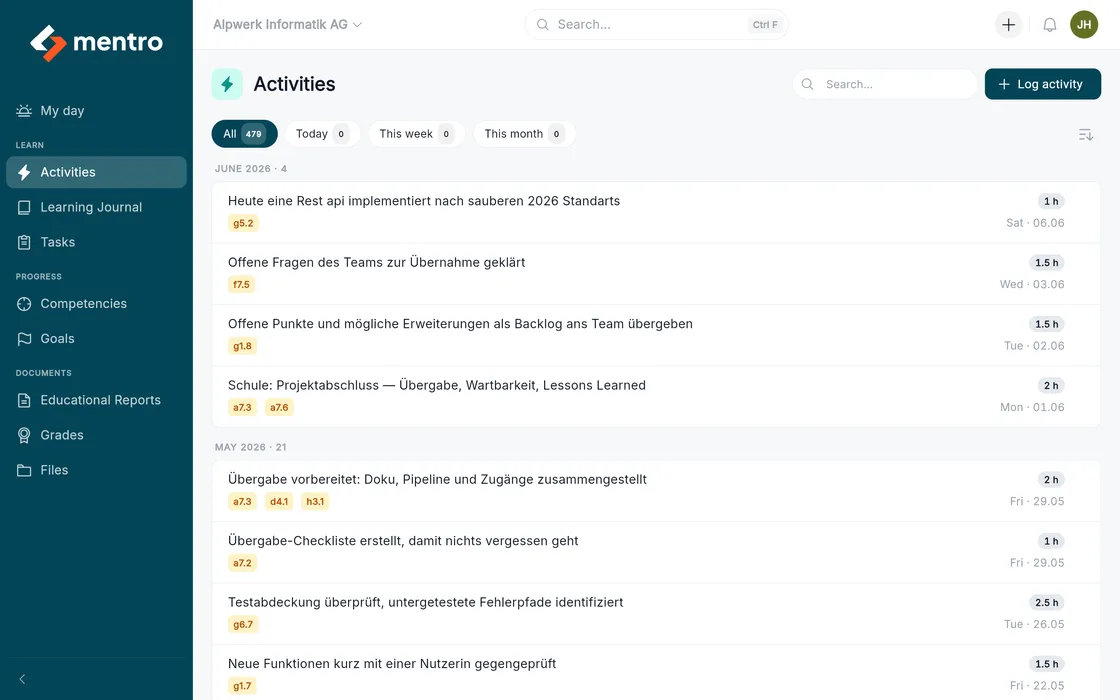
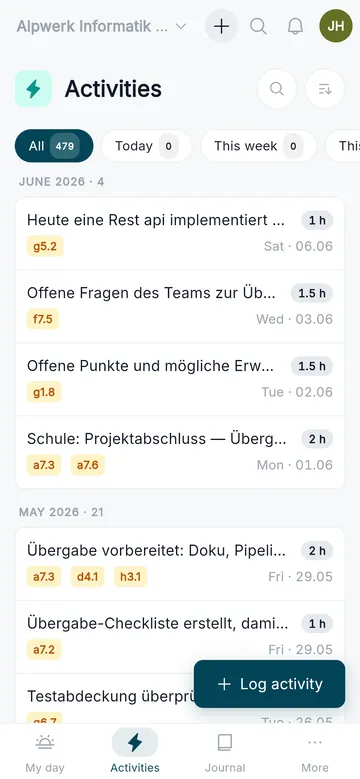
What you worked on, with title, duration and date. Captured in seconds, right after work from your phone.
Learning journals
The reflection on it: what went well, what was difficult and what you will do differently next time.
Link to the curriculum
Every entry is mapped to the operational competences and performance objectives of your curriculum, automatically on saving.
Evidence
Files and results are filed with the activity they belong to. That keeps them findable, even a year later.
Captured in the moment, not at the end of the semester
An activity is typed in within seconds: title, duration, date. On saving, mentro maps the text to the matching operational competences, so you never search through a list.
- Title, duration in hours and date, nothing more
- Automatic competency mapping on saving
- Inter-company courses and vocational school can be captured too
- In the browser on phone, tablet and computer
Your curriculum is already mapped
mentro holds the curricula with areas of competence, operational competences and performance objectives, each with its taxonomy level K1 to K6. Your entries do not land in an empty field but exactly where they belong in the curriculum.
- Computer Science VET, Application Development
- Computer Science VET, Platform Development
- Media Engineering VET
- Digital Business Developer VET
There is no curriculum for the IT Operations specialisation and none is planned: the occupation is being discontinued, and in most cantons no new apprenticeships have started since summer 2023. The «Occupations» page lists which training plans are available.
From the activity to the education report
The learning documentation is not an end in itself. It is the basis for the appraisal meeting and the education report at the end of the semester.
Capture
You record activities and learning journals while the work is still fresh.
Map
mentro links every entry to the matching operational competences of your curriculum.
Reflect
Guided questions in five stages take the reflection beyond short standard sentences.
Assess
At the end of the semester the education report sits on the official SDBB form, with the evidence ready.
Common questions about the learning documentation
Read on
Learning documentation without reconstruction
Request a test environment and see how the documentation grows day by day. The links arrive by email within a few minutes.